How it works
Brand in. Calendar out. Numbers back in.
Four stages, ten steps underneath, and the last one feeds the first. Open any stage.

Cerevia live — walking the city, the council chamber deliberating, and the studio. Not loading? Some networks and VPNs block YouTube — open it directly.
Four stages, ten steps underneath, and the last one feeds the first. Open any stage.
Something happens. A customer says a thing, a campaign lands, a competitor moves. The work starts before anyone has decided what it means.
The signal is recorded as evidence — what was observed, when, and by whom — kept separable from anyone’s reading of it.
Evidence accumulates into claims the system is willing to stand behind, each one still traceable back to what it came from.
Knowledge is held so it can be found again. Not a document graveyard: the reasoning stays attached to the conclusion it produced.
Competing readings are argued out in the open. A red team asks what would have to be true for this to be wrong.
A choice is made and recorded with its dissent — what was decided, on what evidence, and who disagreed at the time.
The decision leaves the system and meets the world, carrying its record with it.
What actually happened is written down against what was predicted. Recording the prediction first is mandatory — a system that never wrote down its guess cannot discover it was wrong.
The gap between the two is the lesson. It attaches to the reasoning that produced the decision, not to the person who made it.
Rules that keep failing get changed. The constitution itself is revisable — in the open, with a record of why.
Point it at your own site. It reads the live pages — name, tagline, colour, logo, the social accounts you actually link to, and what your headings say you do — instead of a questionnaire you fill in once and it forgets. Nothing is inferred or guessed: if a signal is not findable it is reported missing rather than filled in with something plausible. Forty-one charters across seven industry profiles mean it arrives already knowing what matters in your category.
A month, not a post. The calendar is built against your brand and the goal you actually have — lead generation and thought leadership are not judged by the same numbers, so they are not planned the same way. You stop opening an empty month.
Drafts are written against that brand and that plan, with two or three hook variants, each tagged with its attributes: hook type, format, call to action, pillar, length, posting hour. Then a council reads it — sized to what is at stake.
You report what the numbers did. The system pairs the outcome to the decision that produced it and updates what it believes — or refuses to, and tells you why. This is the stage every other tool is missing.
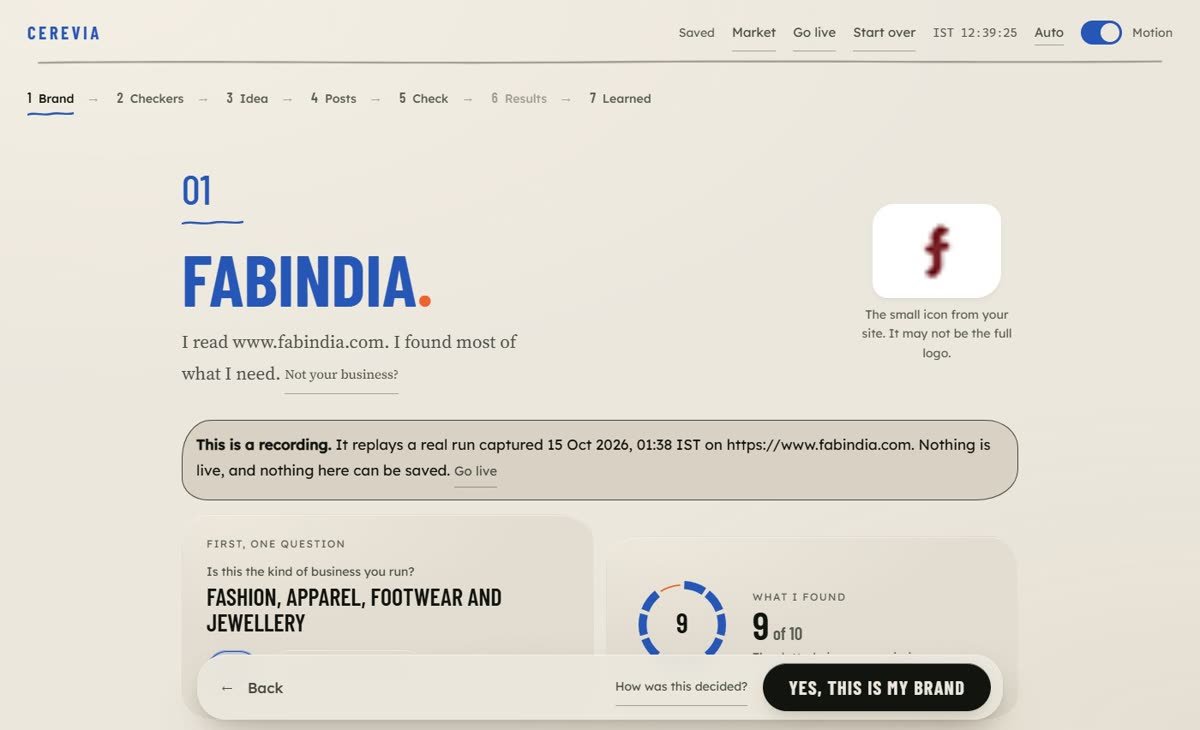
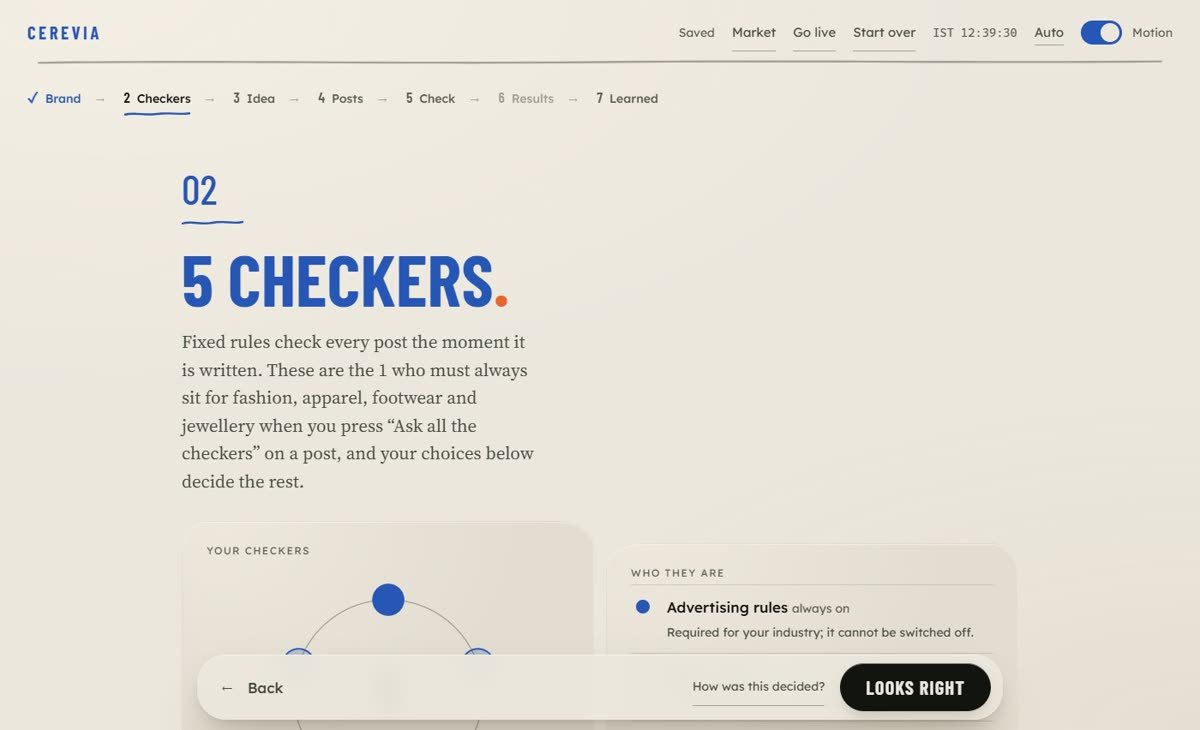
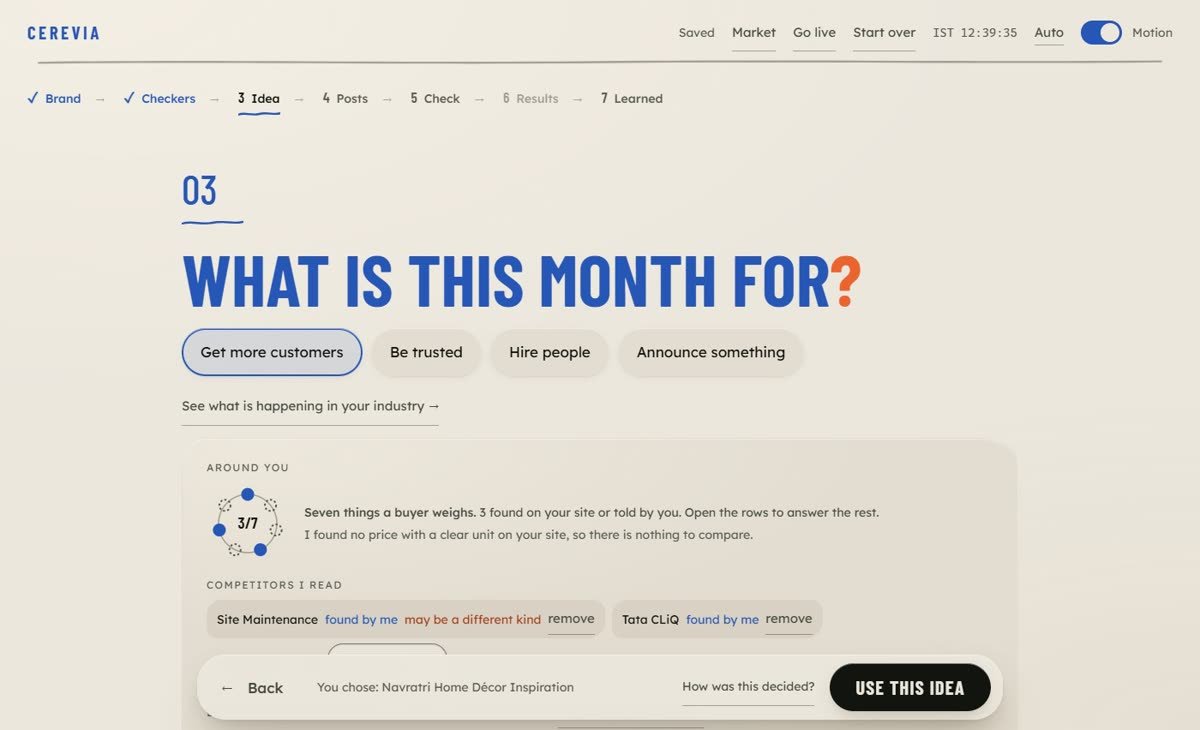
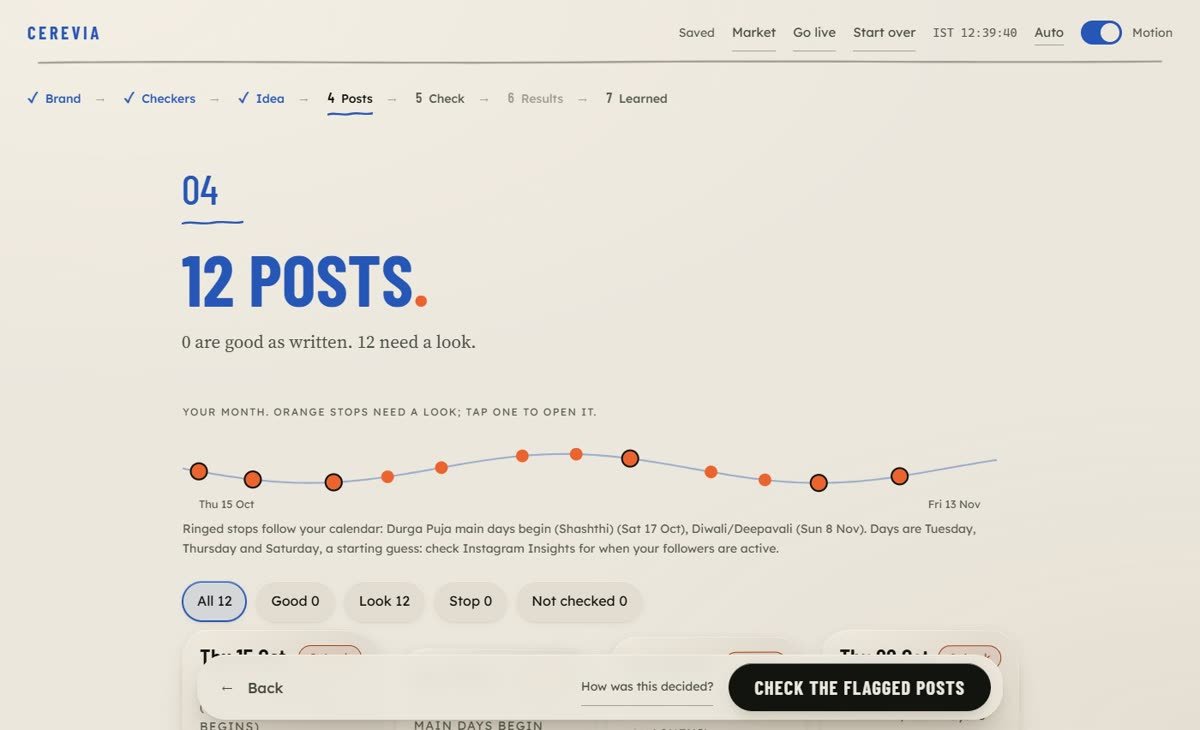
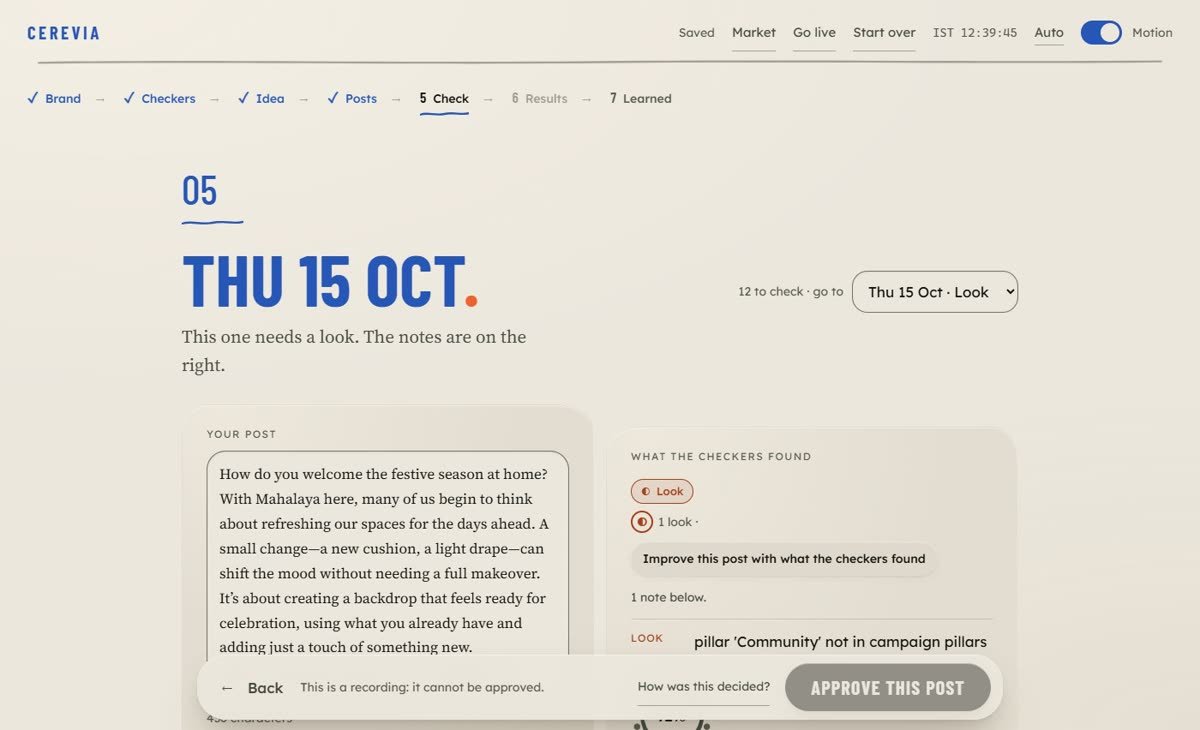
The checkers — a council of independent seats — are not there to slow you down. They are the quality bar that stops the loop drifting into generic AI output over months of iteration — and the reason the system can tell you why something worked, not only that it did.
Cerevia is early. The founding circle shapes what it becomes.